

Performance golf hats are custom caps engineered around a defined playing environment, fit, decoration, and verified fabric behavior. For golf, sportswear, outdoor, and lifestyle brands, the best design is not simply a polyester cap with ventilation. It is a complete system: shell fabric, crown structure, brim, sweatband, closure, perforation or mesh, logo method, and care route must work together. This guide explains how brand and sourcing teams can turn those requirements into an approvable sample and a repeatable bulk product.
Updated October 23, 2026. This guide reflects JoinTop’s current development workflow for custom performance headwear.

What Makes a Golf Hat a Performance Product?
A performance golf hat is designed against measurable product requirements rather than a generic “technical” label. The brief may prioritize low weight, liquid moisture management, drying, airflow, UV protection, light-rain resistance, stretch recovery, or packability. Each claim needs a suitable material, construction, and verification route.
Fiber content alone does not prove performance. Polyester and nylon can be useful starting points because they are available in many weights, weaves, stretch levels, and finishes, but a dense coated fabric can behave very differently from a lightweight uncoated fabric made from the same fiber. The sweatband, lining, seam construction, ventilation, and decoration can also change the finished cap.
Before selecting a fabric, define the golfer, climate, retail position, target market, expected quantity, logo, care method, and delivery date. JoinTop’s broader performance hats guide for brands explains how the same product logic applies across golf, running, training, and outdoor programs.
Performance Golf Hat Specification Matrix
The table below is a development starting point, not a universal pass/fail standard. A brand should rank its priorities and approve the exact material and finished sample for the intended use.
| Brand use case | Useful design direction | Important tradeoff | What to approve |
|---|---|---|---|
| Hot and humid golf | Lightweight woven shell, moisture-managing sweatband, laser perforation or mapped ventilation | More openings can reduce panel stability or limit logo placement | Airflow, drying, sweatband comfort, hole quality, crown shape, and logo appearance |
| High-sun programs | Tested fabric, suitable brim coverage, dark or low-reflection underbrim | A fabric UPF result does not describe uncovered skin or every part of the cap | Test report scope, brim dimensions, covered area, color, and care conditions |
| Light-rain golf | Water-repellent shell or specified barrier construction, depending on the claim | DWR, water resistance, and waterproof construction are different requirements | Test method, pass level, seams, openings, drying behavior, and finish documentation |
| Travel and lifestyle golf | Soft or lightly structured crown, resilient brim, restrained branding | A highly packable build may provide less rigid front-panel support | Recovery after packing, crown profile, brim shape, and logo stability |
| Tournament, team, or pro-shop program | Repeatable core fit, scalable logo method, controlled colors and trims | Many color and logo combinations increase approval and inventory complexity | SKU matrix, color standards, artwork placement, packaging, and reorder controls |
Build the Shell, Sweatband, and Ventilation as One System
Separate moisture management from drying rate
“Moisture-wicking” and “quick-dry” describe different behavior. Liquid transport concerns how moisture spreads or moves through a material; drying concerns how quickly that moisture leaves under defined conditions. A shell may dry quickly while the sweatband remains wet, or a sweatband may absorb well but hold moisture for too long.
Specify which component is being evaluated and which result matters to the wearer. The AATCC TM195 method measures and classifies liquid moisture management properties of textile fabrics. The AATCC TM201 method evaluates fabric drying rate on a heated plate. These are examples of recognized methods; the appropriate method and acceptance level should be agreed for the project.
Use fabric structure and ventilation deliberately
Breathability depends on yarn, weave or knit density, coating, backing, mesh, eyelets, and perforation—not on the fiber name alone. ASTM D737 is a recognized method for measuring the air permeability of textile fabrics. A fabric-level result should be interpreted together with the finished cap because front support, seams, lining, sweatband, and decoration can restrict airflow.
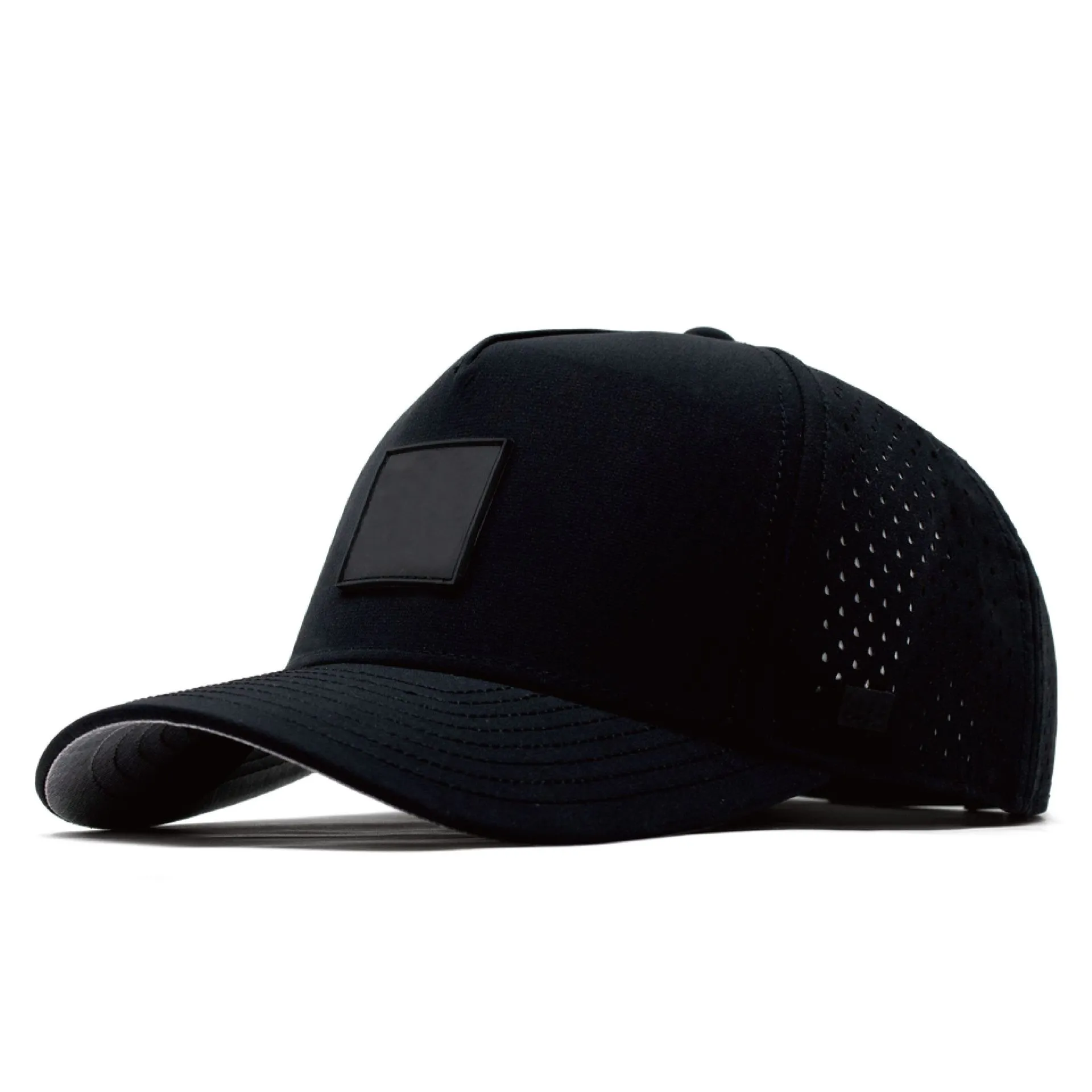
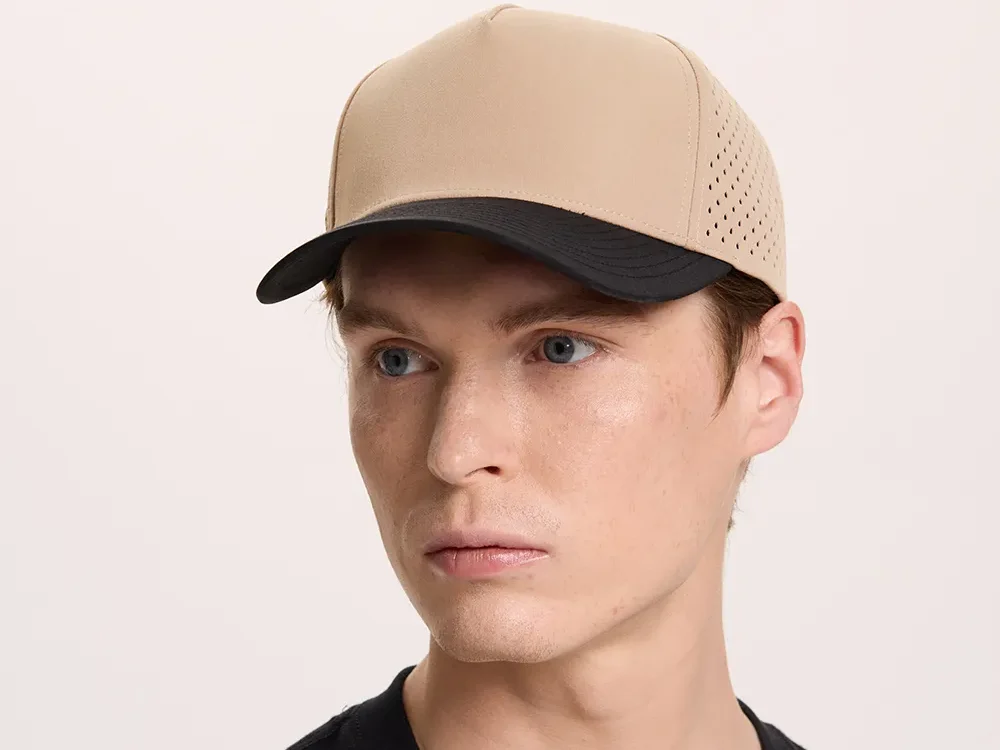
Laser perforation can create controlled ventilation without a separate mesh panel. In JoinTop performance-cap development, 2 mm holes are a common starting reference on suitable 100% polyester fabric, but hole diameter, spacing, location, edge quality, and panel stability must be approved on the actual production material. The laser perforation buyer guide covers the decisions that belong in the tech pack.
Distinguish DWR, water resistance, and waterproof construction
A durable water-repellent finish is intended to reduce surface wetting. It does not by itself make an assembled cap waterproof. A stronger weather claim may require a barrier material, seam control, and a test that matches the intended exposure. Open laser holes or mesh also change what the finished product can reasonably claim.
If a project requires a PFAS-free or fluorine-free DWR route, state that requirement before material selection and request the relevant formulation, supplier documentation, and destination-market evidence. Do not copy a claim from another fabric or previous order. For product planning, compare JoinTop’s waterproof golf cap development guide with the intended level of rain protection.
Choose the Cap Type, Crown, and Brim for the Use Case
The original golf-hat category includes several useful silhouettes. Keep the wearer and channel in view: a pro-shop core cap, a tournament giveaway, a premium lifestyle drop, and a high-sun bucket hat do not need the same construction.
| Hat type | Best suited to | Development focus |
|---|---|---|
| Limite de desempenho | Core golf collections and broad all-round use | Crown profile, low weight, sweatband, ventilation, brim stability, and repeatable fit |
| Mesh-back or trucker cap | Warm climates and golf-lifestyle programs | Mesh handfeel, front-to-back balance, seam comfort, closure, and logo support |
| Viseira | Maximum top-of-head airflow and established golf styling | Band width, front-logo space, sweatband, rear adjustment, and visor angle |
| Bucket or wide-brim hat | Programs prioritizing broader physical coverage | Brim dimensions, structure, packability, chin cord if used, and size grading |
A low-profile unstructured crown can suit a soft lifestyle look, while a mid-profile structured crown gives more support for a front logo. Crown depth should be approved by measurement and wear trial rather than by labels such as low, mid, or high alone. The brim must balance shade, visibility, packability, and brand styling.
Control Fit and Construction with Measurable References
A sample can look correct in a photograph and still fit differently in bulk. Record the measurement method, tolerance, measuring condition, and size reference. For regular adjustable-cap developments, JoinTop commonly works from the following internal starting controls, then adapts them to the approved style:
- Finished head circumference: 58 cm with a ±0.5 cm working tolerance
- Visor-to-body reference: 20–20.5 cm, measured by the agreed method
- Brim inner core reference: 7.2 cm with a ±0.3 cm working tolerance
- Front artwork clearance: generally at least 1 cm from a major sewing line before pattern-specific confirmation
These are JoinTop development references, not universal industry standards. Crown depth, visor length, sweatband width, closure range, and grading should follow the brand’s wearer and approved sample. For more detail, use the performance cap fit specification guide.
Fit also depends on material stretch and recovery, panel seam allowance, front support, and the closure. If a stretch fabric, elastic closure, or larger size is required, approve the decorated cap in the relevant size. Dense embroidery or a large patch can change the way a lightweight front panel sits.
Select a Logo Method That the Cap Can Support
The most visible branding area is often the part most affected by technical construction. A lightweight perforated front or side panel may not support the same stitch density as a firm twill cap. Test the real logo at the real size and position.
| Logo route | Why a brand may choose it | Key sample checks |
|---|---|---|
| Bordado plano | Versatile, familiar, and suitable for many golf identities | Stitch density, edge clarity, backing, puckering, seam clearance, and reverse-side comfort |
| Bordado 3D | Raised impact for bold lettering or simple marks | Foam height, corners, small gaps, panel stability, and weight on the crown |
| Woven or embroidered patch | Fine detail or a layered heritage appearance | Patch scale, border, attachment, weight, and wash behavior |
| TPU, silicone, or heat-applied badge | Clean technical appearance and dimensional branding | Heat and pressure response, bond, color migration, gloss marks, and flexibility |
| Print or transfer | Low-profile graphics and certain fine or multicolor designs | Surface compatibility, opacity, stretch, abrasion, and care durability |
Large heat-applied logos need enough flat panel area and controlled pressure. In JoinTop developments, a front panel of about 12 cm can often be pressed with the right fixture, while artwork extending across an entire 16 cm front area may be impractical to press evenly because of seams and crown curvature. Confirm feasibility from the pattern and mock up before creating molds. The lightweight-cap embroidery guide explains how to reduce puckering risk.
Match Every Performance Claim to Evidence
A buyer should be able to connect each public claim to a component, test method, sample condition, and acceptance level. The following methods are examples for building that plan; they are not a substitute for requirements set by the destination market, retailer, or testing laboratory.
| Claim or concern | Possible evidence route | Important limitation |
|---|---|---|
| Liquid moisture management | AATCC TM195 on the selected fabric | A fabric result does not describe the complete cap or sweatband by itself |
| Drying rate | AATCC TM201 or another agreed drying method | Method, water amount, temperature, and component tested affect the result |
| Air permeability | ASTM D737 on the selected fabric | Coatings, support layers, seams, and decoration alter the finished construction |
| Proteção UV | AATCC TM183 on the actual fabric and relevant condition | Coverage, openings, color, wet state, and care can affect how the claim applies |
| Surface repellency or water resistance | An agreed spray, rain, impact, or hydrostatic-pressure method suited to the claim | Water repellency, resistance, and waterproofness are not interchangeable |
| Color durability | Methods selected for perspiration, rubbing, light, water, or laundering as relevant | Choose exposures that match the use case and colorway |
Ask the supplier or laboratory to identify the exact material, color, finish, test date, test method, and result. If the shell fabric or finish changes after approval, review whether the evidence must be renewed. For UV-specific planning, see the performance cap UPF testing guide.
Use a Controlled Sample-to-Bulk Workflow
- Commercial brief: confirm the brand, intended golfer, climate, sales channel, destination market, quantity by style and color, launch timing, and target delivery date.
- Technical brief: define crown, brim, fabric, sweatband, ventilation, closure, logo, trims, labels, packing, and any performance or compliance claim in the performance cap tech pack.
- Material approval: record supplier reference, composition, color standard, weight or thickness when relevant, stretch, finish, handfeel, and required evidence.
- Mock up and first sample: confirm artwork scale and position before sampling, then review the physical cap for fit, appearance, workmanship, and function.
- Written revisions: use measurable comments and keep an approved reference. Do not approve color, surface texture, or fit from screen images alone.
- Pre-production control: confirm production material and trims against approved references; request a pre-production sample when the program risk or buyer process requires one.
- Bulk quality control: inspect measurements, workmanship, logo, colors, functional details, packing, and agreed documents before shipment.
As of October 23, 2026, JoinTop’s standard MOQ for regular caps is 100 pieces per color and style; colors cannot be mixed to reach that MOQ. Typical sampling takes 20–25 days for one or two styles, while three to five styles may need about 30 days. Bulk production is normally planned at 40–45 days after approvals and order confirmation. Custom-dyed materials, special trims, testing, revisions, peak periods, and complex decoration can extend the schedule, so confirm the exact timeline before announcing a launch.
For a program moving from concept to repeated orders, review JoinTop’s custom headwear cooperation process e o sample-to-bulk quality control guide before finalizing the purchase calendar.
Bulk Quality Checks for Performance Golf Hats
A useful inspection plan follows the approved sample and purchase specification. It should separate appearance, measurements, function, and packing instead of relying on a general “looks good” decision.
- Fit and shape: head circumference, crown depth, visor-to-body relationship, brim curve, symmetry, and closure range
- Workmanship: panel alignment, seams, stitch tension, loose threads, sweatband attachment, eyelets or perforation, and brim edge
- Branding: logo size, placement, color, density or bond, edge quality, puckering, and consistency across units
- Materials and color: approved shell, sweatband, closure, trims, shade, handfeel, finish, and production-lot consistency
- Functional details: perforation quality, stretch recovery, adjustment, packability, and any agreed test or documentation
- Packing: shape protection, count, labels, inserts, poly bags, cartons, shipping marks, and destination requirements
Test reports do not replace workmanship inspection, and a visual inspection does not validate a performance claim. Use both when the specification requires both.
Plan Seasonal Assortments and Care Instructions
For hot-weather golf, prioritize the lowest practical weight, ventilation, sweatband comfort, and drying route that still supports the selected logo and crown. For cooler or windier conditions, a denser fabric may improve coverage and structure but can reduce airflow. A dark underbrim may help manage reflected light visually, while the final color assortment should follow the brand’s apparel range and channel needs.
Validate care on the complete decorated cap. The shell, sweatband, brim core, thread, backing, adhesives, badge, labels, and hardware can respond differently to water, detergent, agitation, and heat. Approve the intended method and check dimensional change, color transfer, delamination, logo distortion, surface damage, and brim shape after care.
Performance Golf Hat FAQs for Brand Buyers
What is the best fabric for a performance golf hat?
There is no universal best fabric. Lightweight polyester or nylon constructions are common starting points, while stretch blends can support closer fit and recovery. Select the exact fabric from the climate, handfeel, crown, ventilation, logo, care, and test requirements, then approve it in a finished sample.
Does polyester automatically make a cap moisture-wicking or quick-dry?
No. Polyester identifies a fiber, not a verified performance result. Yarn, weave, finish, sweatband, ventilation, and cap construction all matter. Moisture transport and drying should be specified and evaluated separately.
Can a brand claim UPF 50+ from the fabric name?
No. A UPF claim should be supported by a relevant report for the actual fabric and applicable condition. The result applies to the tested material; cap openings, mesh, uncovered areas, color, wet state, and care conditions still need to be considered.
What logo methods work on lightweight golf caps?
Flat embroidery, selected patches, printing, transfers, and lightweight heat-applied badges can work, depending on the fabric and crown. Dense 3D embroidery or a heavy patch may distort a light panel. Approve the real logo at production size on the actual cap construction.
What is the MOQ and sample lead time for custom performance golf hats?
As of October 23, 2026, JoinTop’s standard MOQ for regular caps is 100 pieces per color and style. One or two styles usually require 20–25 days for sampling; three to five styles may require about 30 days. Special materials, custom dyeing, molds, testing, and revisions can add time.
How can a brand reduce sample-to-bulk variation?
Use a complete tech pack, approve physical materials and a decorated sample, record measurable comments, retain reference samples, confirm production materials before assembly, and inspect bulk goods against the same specification. Do not rely on photos alone for color, handfeel, fit, or surface finish.
Start Your Custom Performance Golf Hat Project
A reliable golf-headwear program starts with a clear use case and a controlled approval path. Send JoinTop your company or brand, product type, intended golfer and climate, estimated quantity by style and color, target market, logo, preferred material or reference cap, delivery destination, and required arrival date. The team can then identify realistic fabric, construction, decoration, sampling, and testing routes.
Explore JoinTop’s custom sports and performance caps, review the private label golf cap sourcing guide, ou request samples and a custom performance golf hat quotation.

 PT
 EN
 ES
 FR
 AR
 JA
 KO
 RU
 DE
 IT
 TR