

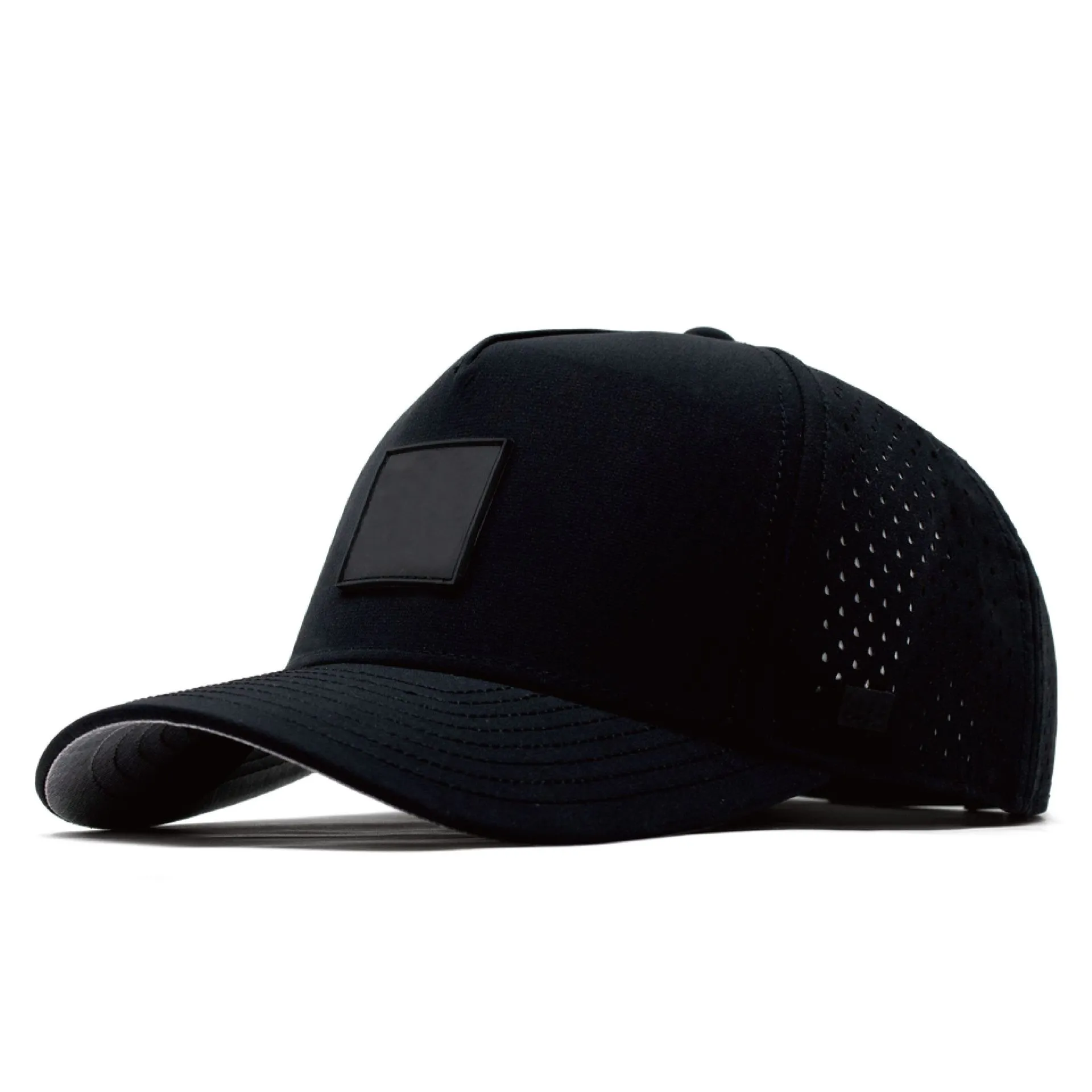
Performance cap logo placement should be defined from repeatable reference points on a supported cap. Record the artwork size, position, orientation, measurement method and approved tolerance. A mockup that looks centered on a flat screen cannot fully define the position of a logo on a curved, assembled crown.
This guide helps brand design and sourcing teams turn artwork into an instruction that the sample room and bulk inspectors can reproduce. It applies to embroidery, patches, transfers and other decorations, with process-specific limits agreed during development.

State which part of the artwork is being measured
Provide an identifiable artwork revision and the intended finished dimensions. Define whether width and height include a border, background or transparent margin. A file's artboard can be larger than the visible logo, which creates ambiguity if the instruction only refers to file size.
For scalable artwork, Adobe's explanation of raster and vector files distinguishes pixel images from scalable shapes. A vector source helps preserve defined geometry, but the decoration process still needs its own production file and sample approval.
Do not assume a file extension proves the artwork is editable vector content. Ask the artwork team to confirm the actual contents and resolve fonts, color references and outline requirements before production preparation.
Define the cap's measurement condition
State how the cap is supported and how the closure is set. Define whether the visor is in its approved curve. A soft crown measured flat can produce a different apparent center from the same cap on a form.
| Placement field | Instruction to define | Ambiguity prevented |
|---|---|---|
| Horizontal reference | Named seam, panel center or agreed centerline | Different interpretations of center |
| Vertical reference | Named edge and measurement direction | Inconsistent height above the visor |
| Artwork boundary | Visible edge or another defined point | Measuring the file margin |
| Cap condition | Support, closure and visor setting | Comparing different crown shapes |
Use a dimensioned drawing together with the physical sample. Specify whether a measurement follows the surface or uses a direct projection. The useful method is the one the brand and supplier can repeat reliably.
Review optical alignment as a separate decision
An asymmetric symbol can appear off-center when its bounding box is mathematically centered. Identify whether the brand wants geometric centering or a deliberate visual adjustment. Approve that adjustment on the supported cap rather than leaving it to each operator.
Keep the approved visual position and the measurement instruction consistent. If the brand moves the symbol after seeing a sample, update the drawing and production reference. A photograph in a comment thread should not conflict with the current specification.
Allow for the decoration process and construction
Review seams, support layers, perforations and the available application area. A patch spanning a curved panel may contact the fabric differently from a narrow transfer. Embroidery across a seam can shift visually as the crown relaxes.
Use the actual finished fabric and support in the approval sample. Agree achievable position and size tolerances from the intended process. A graphic designer's screen measurement alone cannot establish a bulk manufacturing capability.
| Decoration route | Additional placement review | Approval evidence |
|---|---|---|
| Stickerei | Seam crossing, stitch distortion and inside backing | Supported sample and digitized-file revision |
| Pflaster | Patch edge, curvature and attachment position | Patch dimensions and installed sample |
| Transfer | Platen support and position after bonding | Finished application with process reference |
| Side or back logo | Closure, panel seam and size variation | Views and dimensions for that location |
Create an inspection reference that survives handover
Record the finished logo size, datum dimensions, acceptable position range and viewing method. Include clear photographs with the cap in the specified condition. Identify who can approve a deviation and how that approval is limited.
ISO 10007 (2017 edition) gives general configuration-management guidance. For decoration, control the artwork, specification and sample revisions together so that inspectors do not compare a new cap with an obsolete logo instruction.
Review the first bulk output before the full order is decorated. If the logo looks different, measure it under the agreed condition before changing the jig. A crown or fabric issue can resemble a placement error.
Connect placement to your collection brief
Use the Anpassungsoptionen, lightweight cap embroidery guide Und tech pack checklist to define the complete decoration package. Include all locations, colors and sizes required for the collection.
Questions about logo position
Is a centered mockup enough for sampling?
Use it as a visual reference, then add artwork dimensions, a cap datum and a defined measurement condition. Confirm the result on the actual cap.
Should the logo follow the front seam?
State the intended reference. Some constructions have no central seam, and an asymmetric logo may need a deliberate visual adjustment.
Can every logo use the same position tolerance?
Review the design, location, cap construction and decoration process. Agree a tolerance the supplier can demonstrate on the intended setup.
Does changing logo size require another review?
Review how the new size fits the curved area and nearby seams or openings. Update the artwork and placement references together.
What files should a brand send?
Send the source artwork, finished dimensions, color references, location drawings and any approved physical sample. Identify the current revision clearly.
Prepare your decoration brief
Für eine performance cap collection, send your brand website, style, quantities per color, logo files, target market, destination and delivery date through Kontaktieren Sie uns or the form below. Include the logo locations and the approval references you want the sample team to follow.

 DE
 EN
 ES
 FR
 AR
 JA
 KO
 RU
 PT
 IT
 TR