

Hat fabric delamination is the separation of layers that were intended to stay bonded. For performance-cap brands, the practical response is to identify the affected layers, reproduce the relevant care or finishing conditions, and agree on a bond and appearance check before bulk approval. A wrinkled seam, loose coating or peeling logo may look similar, but each needs a different investigation.
Not every five-panel or six-panel cap uses laminated crown fabric. A single woven shell, a bonded shell, a fused front support and a heat-applied logo have different constructions. Record which part is separating before changing the supplier or promising a performance claim, and keep a physical reference of the sample under review.

Why hat fabric separates and what to inspect
Start with the exact location. Separation between two layers of crown fabric points to the bonded material system. A front panel that lifts away from reinforcement may involve an interfacing or assembly step. A logo edge lifting from the surface concerns decoration. If a coating cracks or flakes without two textile layers separating, document it as a surface issue until the construction is confirmed.
Photograph the face, reverse, edge and location on the cap. Record the style, sample revision, color, fabric article, supplier and any processing or care performed before the issue appeared. Compare an affected piece with an unexposed sample from the same known material when one is available. A visual change is useful evidence; it does not, on its own, establish the chemical or mechanical cause.
Preserve the affected sample rather than trying to repair every loose edge before review. Mark whether the change appears near a cut edge, a seam, a pressed logo or an unsupported flat area, and record when it was first observed. This gives the supplier and laboratory a more useful comparison than a cropped photograph or a statement that the entire fabric has failed.
If you are reviewing a performance-cap reference, send JoinTop the cap style, affected area and intended use. A clear component map and photos of both sides help the development discussion focus on the material and the stage that need checking.
Specify the construction instead of buying a fabric name
Ask the supplier for a layer description, not simply “waterproof fabric” or “performance material.” A purchase specification should identify the face textile, any film or backing, the bonding or coating system where known, front reinforcement, sweatband construction and decoration. Include the supplier’s article number and color route so the sample and bulk material can be traced to the same system.
| Construction or component | Buyer decision | Risk to verify |
|---|---|---|
| Single-layer shell with a finish | Define the textile and finish separately. | Surface durability and stated water behavior; there may be no bonded shell layers to peel. |
| Bonded or laminated shell | Identify face, backing or film and intended use. | Bond condition before and after the agreed exposure or care. |
| Fused front reinforcement | Name the support and bonding process. | Lifting, bubbling or shape change in the assembled front. |
| Heat-applied logo or patch | Specify the decoration and application conditions. | Edge lifting, distortion and interaction with the shell. |
| Sweatband assembly | Identify face, backing, foam and seams. | Separation, fit and appearance where layers are present. |
Each option has a different trade-off. A single-layer shell with a surface finish may be simpler to describe, while a bonded structure can be selected for a particular design or performance requirement. Neither construction is automatically better for every cap. Compare the complete material against the intended water behavior, feel, weight, breathability, shape and care instructions using measurements relevant to the project.
A finish that encourages water to bead is not proof that seams, logos or the complete cap are waterproof. Likewise, a water-repellency result does not establish bond durability. Keep water behavior and layer adhesion as separate requirements, with separate samples and acceptance criteria where needed. This prevents one favorable fabric result from obscuring a construction issue.
Trace dyeing, finishing and assembly in the sample record
Document the order of operations for the material submitted for approval: base fabric, dyeing or printing, bonding or coating, any water-repellent treatment and cap assembly, as applicable. The sequence is a traceability record, not a shortcut to assigning blame. Ask the material supplier which combinations have been evaluated and what additional check is appropriate when a step or supplier changes.
If a brand needs a PFAS-free water-repellent option, state that requirement in the brief and ask for evidence appropriate to the material and destination market. PFAS-free wording describes a chemical requirement; it does not establish water resistance, adhesion or durability. Verify those properties separately on the relevant material and finished cap, and avoid claiming certification without documentation.
Ask what the supplier’s chemical documentation actually covers: the finishing product, the finished fabric, or another component of the cap. A declaration or a screening result should be interpreted within its stated substance scope and detection limits. If the brand needs a particular claim, agree on the required supporting evidence and review it for the intended market before approving product copy.
Color can affect the sourcing decision even when all versions look alike in a catalog. Record whether each color is an existing material or requires a separate dyeing route, and identify any additional finish applied afterward. Select representative colors through a documented risk review with the supplier and laboratory instead of assuming that one approved shade covers every process variation.
Where the original construction cannot meet the agreed checks, evaluate an alternate material against the full brief: color match, hand feel, shape, decoration, care and the specific performance requirement. The material substitution control guide helps document what changes and which evidence needs to be updated before a replacement becomes the new production reference.
Choose a test that matches the material and the failure
For bonded, fused or laminated apparel fabrics, ASTM D2724 describes a method for characterizing bond strength before or after drycleaning and laundering. Ask the laboratory whether the cap material and specimen can be prepared within the method’s scope, which direction and interface will be tested, and how the result will be reported. Do not apply a bond-strength method to a component that has no bonded interface.
The laboratory and brand should agree on the specimen identity, comparison, conditioning, test direction, number of specimens and acceptance rule before testing. Keep the method edition with the report. There is no single bond-strength value in this guide that makes every cap acceptable; the threshold must be agreed for the construction, intended use and reporting method.
To prepare an after-care comparison, ISO 6330 specifies domestic washing and drying procedures for textile testing. It is a conditioning procedure, not a universal pass or fail rule for delamination. Agree on the applicable machine or hand-care process, cycles, detergent and drying conditions, and ensure they reflect the care instructions proposed for the finished cap.
For the appearance of apparel and other textile end products after domestic washing and drying, ISO 15487 describes an assessment method. Confirm with the laboratory whether it is appropriate for the cap and the appearance question being asked. Document visible bubbling, edge lifting, coating change and shape separately from any numerical bond result.
| Sample group | What it checks | Information to record |
|---|---|---|
| Unconditioned material | Initial bond or appearance reference. | Article, color, supplier, lot and specimen direction. |
| Material after agreed care | Change after defined washing and drying. | Procedure, cycle count, detergent, drying and test date. |
| Assembled development cap | Shape and vulnerable interfaces in construction. | Style revision, size, logo, sweatband and front support. |
| Material after a process change | Whether changed dyeing, finish or bonding needs review. | Old and new processes, supplier and comparison plan. |
| Production-lot reference | Continuity with the approved material. | Purchase order, roll or lot, retained sample and inspection record. |
A material can pass an initial screen and still require an after-care check when the intended claim depends on continued performance. Conversely, a finished cap may show a seam or reinforcement issue while a separate shell specimen meets its bond target. Keep the laboratory result and the whole-cap observation together, but do not treat them as interchangeable.
Before committing to a sample run, ask JoinTop to review the proposed fabric layers, finishing route and sample plan. Share the intended care instruction and any photos or reports so the discussion can identify the specific interface and conditions to verify.
Turn a lab report into a buying decision
Review the report against the purchase specification. Check that the supplier, fabric article, layer construction, color, finishing route and conditioning match the material actually proposed for the cap. Ask for an explanation of deviations and whether the reported result covers the exact interface at issue. A report for a similar fabric may help screen a supplier but should not be represented as a test of your approved sample.
Record the brand’s decision beside the result: approved for the stated use, approved subject to a repeat check, or held while the material or construction changes. If the result is borderline, agree on the next action before selecting another specimen. Repeating tests until a favorable number appears is not a reliable substitute for understanding sample variation and the agreed acceptance rule.
A supplier comparison should use a shared brief. Ask each candidate for the same component information, specimen plan, condition and reporting format. Compare lead times, testing responsibilities and substitution procedures as quoted for that project, rather than relying on an assumed industry standard. A lower initial material cost is difficult to judge if it leaves the failure mode or rework responsibility undefined.
Include the proposed quantity and color split when requesting that comparison. Some fabric routes, special colors or finishes may have minimum quantities or separate setup requirements; these must be confirmed for the actual material. Ask how many sample versions will be supplied, who retains the approved reference, and what must be settled before the factory purchases bulk fabric.
Approve the finished cap, not only the swatch
A five-panel or six-panel cap introduces seams, curved panels, embroidery or patches, a sweatband and a brim. Inspect the areas where materials meet after the agreed conditioning: the crown edge, front support, sweatband join, back opening and decoration. Check symmetry and shape as well as visible lifting. The sample approval checklist can link these observations to the approved cap revision.
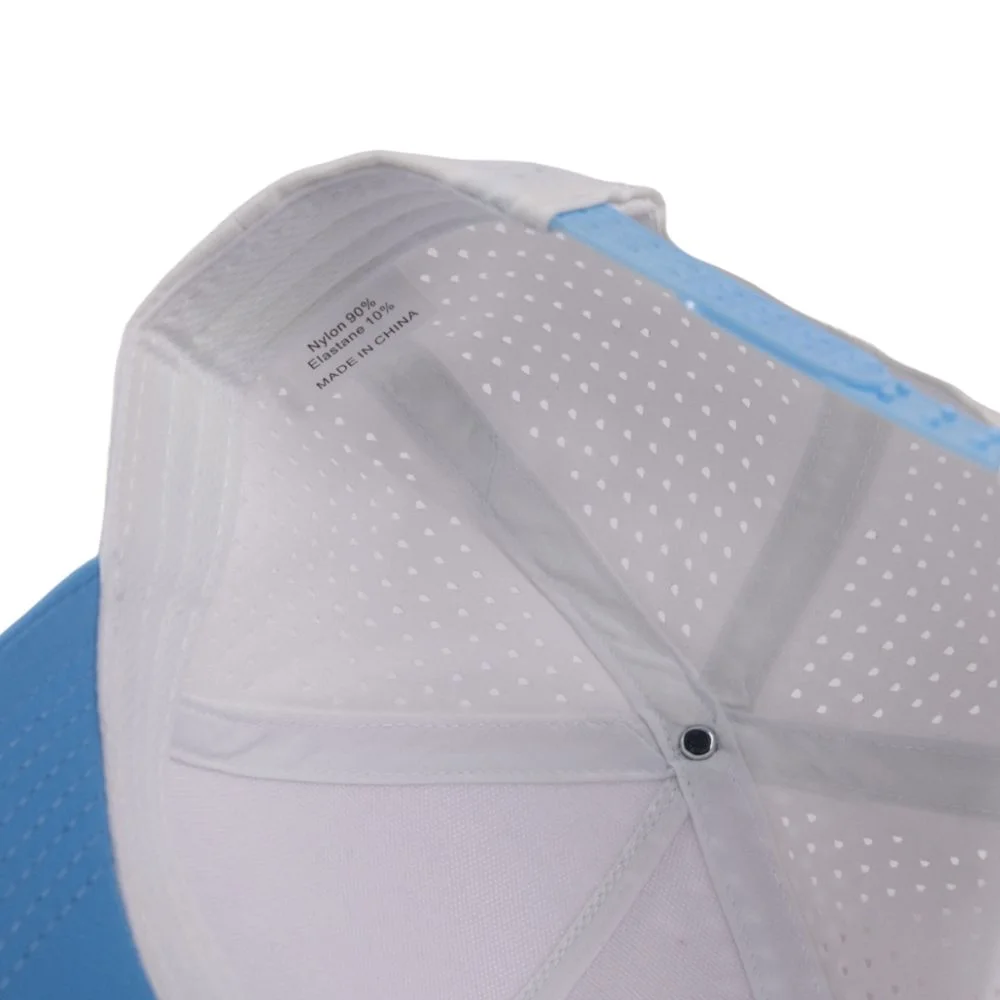
For a perforated design, record whether the holes are cut before or after any bonding and whether the supplier has assessed the finished edges. Hole shape or size alone does not prove that layers will separate. Ask the factory to show the approved production process and inspect representative areas after the agreed care or use exposure.
Review the brim insert and decoration before choosing whole-cap washing conditions. A process suitable for a flat material specimen may distort the finished cap or affect a logo. The care-instruction validation guide helps the brand compare the planned label with the actual construction and document any restrictions supported by the approved test.
If the logo is applied with heat or pressure, compare a decorated sample with an otherwise comparable undecorated piece after the agreed process and care. The result can help identify where further investigation is needed, but it cannot isolate a cause unless the variables are controlled. Record the decoration revision and application details alongside the material sample.
Control changes through production and reorders
At bulk handover, attach the accepted material specification, layer description, color reference, care instruction, report and signed-off cap revision to the purchase record. Use the production handover checklist to state who verifies each item and when work may proceed. Retain an identified reference sample when the parties agree it is needed for comparison.
Flag changes to the mill, backing, adhesive, bonding process, dye route, finish, decoration or care label before production. A change is a reason to review relevance, not proof that the material will fail. The brand and supplier can agree on a targeted check or retest based on what changed and which prior evidence still applies.
For the first bulk lot, agree on where and when the material will be inspected, how any suspect roll will be identified, and who can authorize replacement or release. Keep the inspection record connected to the purchase order and retained reference. At reorder, review any documented changes before assuming that an earlier laboratory report covers the new lot.
- Name the component and the layers that are expected to remain bonded.
- Record the material article, supplier, color and process sequence.
- Separate water behavior, bond strength and finished-cap appearance requirements.
- Agree on specimens, care conditioning, method edition and acceptance criteria.
- Compare the approved swatch with the assembled cap at vulnerable joins.
- Record production-lot traceability and the changes that require review.
For a bonded-fabric review or quotation, send JoinTop your construction brief with a reference cap or style, five-panel or six-panel construction, quantity per style and color, colors, logo file and preferred process, target market, performance requirements, delivery destination and target date. If a sample has separated, add clear photos, the known layer description, its processing history and any available test report.

 ES
 EN
 FR
 AR
 JA
 KO
 RU
 DE
 PT
 IT
 TR