

Performance cap moisture-wicking testing should measure the fabric and sweatband in the direction that perspiration moves during wear. Wicking, absorption, one-way transport, drying and air permeability are different properties, so one result cannot stand in for the others. Brand buyers should identify each component, specimen face, test direction, conditioning, acceptance rule and bulk verification method before approving a moisture-management claim.
Define the moisture function before selecting a test
A runner may want sweat to leave the skin-side surface, spread across a larger area and dry without a heavy wet band. A golfer may value a soft sweatband that absorbs intermittent moisture without marking the shell. Those products need different balances.
Start with the wearer problem and turn it into measurable properties. Do not ask for moisture wicking as a single pass or fail line. State whether the priority is vertical transport, spreading, one-way transfer, absorption capacity, drying time or a combination.
| Property | What it describes | Buyer use |
|---|---|---|
| Wicking rate | Liquid travel along or through a textile | Compare shell and sweatband transport |
| Absorption | Liquid taken into a material | Assess initial sweat capture |
| One-way transport | Movement from the skin side toward the outer side | Review directional comfort design |
| Drying time | Moisture loss under defined conditions | Estimate wet-weight persistence after use |
Match the method to the decision
AATCC TM195 measures, evaluates and classifies liquid moisture-management properties of woven, knitted and nonwoven fabrics. Its official scope connects the result to water resistance, repellency, absorption, fabric structure and fiber or yarn wicking.
AATCC TM197 evaluates the ability of vertically aligned textile specimens to transport liquid to specified distances. It applies to woven, knitted and nonwoven fabrics. A buyer may use these methods for different decisions, so report names and specimen details must remain attached to every number.

Test the shell and sweatband as separate systems
The crown shell controls heat and moisture across a broad area. The sweatband sits against the forehead and may contain face fabric, foam, elastic, nonwoven backing and stitching. A strong shell result cannot describe a multi-layer sweatband.
List each construction in the tech pack and decide whether the laboratory tests a single layer or the assembled laminate. The performance cap sweatband guide helps define width, stretch, material and attachment before testing begins.
Map the forehead, temples, side panels and back opening because moisture load is not uniform during wear. The front sweatband usually receives more direct liquid, while side panels may be expected to spread and release moisture. A component map lets the buyer set different requirements without forcing one material to do every job.
| Component | Specimen decision | Common source of variation |
|---|---|---|
| Crown shell | Face side, back side and grain direction | Finish level, color and panel stretch |
| Sweatband face | Skin-contact surface and direction | Yarn, brushing and finish |
| Sweatband laminate | Complete layer stack when possible | Foam density, adhesive and backing |
| Оболочка | Separate or combined with shell as worn | Coverage and seam attachment |
Record direction and specimen orientation
Liquid movement can differ between the fabric face and back. For a cap, the test brief should identify the side against the wearer and the intended outward direction. Vertical wicking also depends on how the specimen is cut relative to warp, weft or knit course.
Mark orientation on retained swatches. If side panels are cut on another direction or stretched around the crown, include that in the sample map. A number without direction can hide a meaningful difference.
Keep specimen size and edge preparation consistent. Frayed edges, adhesive residue or heat-cut boundaries can change the liquid path. When the production panel is laser cut, decide whether the laboratory specimen represents the base textile or the finished edge condition and label the report accordingly.
Control conditioning, liquid and environment
Laboratory temperature, humidity, specimen conditioning and test liquid affect results. Use the method's stated procedures and ask the lab to report deviations. Factory demonstrations can support development, but they should not be presented as equivalent to controlled laboratory data.
Agree whether testing occurs on new material or after defined care, abrasion or sweat exposure. Keep the choice consistent with the claim and care instructions.
Set acceptance criteria from an approved benchmark
There is no universal wicking number for every running, golf or outdoor cap. Build the target from an approved reference product, laboratory method and intended user experience. Compare specimens tested under the same setup.
For a new program, test two or three candidate constructions before locking a value. Record the range and choose a limit that production can repeat. Avoid a target taken from another material type or an unrelated garment.
| Development step | Evidence | Buyer decision |
|---|---|---|
| Reference review | Existing product and wearer problem | Which moisture property matters |
| Material screening | Comparable laboratory or controlled factory results | Which fabrics enter sampling |
| Finished sample | Component identity, fit and wear observations | Whether the system feels and performs as intended |
| Specification lock | Approved report and retained swatches | What bulk must match |
Pair wicking with drying and breathability
A fabric can move liquid quickly and still dry slowly. It can also wick well while limiting air movement. Review the properties together when the product promise includes cool, dry or quick-dry language.
Use the drying-rate test guide for evaporation controls and the breathability testing guide for air-permeability decisions. The combined file gives product teams a clearer picture than one headline result.
Fabric weight and surface area also affect the wear experience. A textile that spreads liquid over a broad area may show a larger visible wet zone even while helping evaporation. Decide whether the brand prioritizes transport speed, dry appearance, low wet weight or skin-side dryness. Product copy should reflect the selected outcome.
Check finishes, colorways and logo backing
Water-repellent finishes can slow initial wetting, while hydrophilic treatments can support spreading. Dyeing, softeners and print layers may change the behavior of the same base fabric. Test the approved production finish rather than an untreated development swatch.
Dense embroidery backing and large heat-transfer logos can block moisture movement through the front panel. Include decorated panels in the finished-cap review, especially when the logo covers a large portion of the crown. Keep the logo size and backing specification tied to the approved result.
Use wear trials to confirm the laboratory decision
A small wear trial can reveal pressure, wet cling, sweat migration and visible staining that flat specimens cannot show. Use the same activity, duration and review form for each candidate. Wear observations should support material selection, while laboratory data provide the repeatable specification.
Record fit size, environment, activity and care state for each trial cap. Avoid presenting a few wearers as statistical proof. Their feedback is most useful for finding construction issues before the sample is locked.
Check the finished cap for moisture paths
Panel seams, fusible support, logo backing and sweatband stitching can interrupt liquid transport. Review wetting around the forehead, temple and front-panel transition. A flat fabric specimen cannot reveal every assembled-cap path.
Use a controlled amount of test liquid and record placement, time and observations. Photograph the inside and outside at consistent intervals. Treat this as a product-development check unless the setup has been validated as a formal acceptance method.
Control moisture performance in bulk production
Incoming material checks should confirm supplier, fabric code, composition, weight, construction, finish and color. Compare those records with the approved swatch. The fabric weight and thickness guide provides related controls.
Bulk testing frequency should reflect risk. Retest after changes to mill, yarn, finish, laminate, sweatband supplier or color when the change could affect the claim. Keep lot-level traceability even when routine release relies on identity and workmanship checks.
| Bulk checkpoint | Control | Escalation trigger |
|---|---|---|
| Incoming shell | Code, roll, weight, color and finish identity | Unapproved mill or construction change |
| Incoming sweatband | Layer stack, width, stretch and supplier | Different foam, backing or face textile |
| Sewing line | Attachment tension and uninterrupted moisture path | Puckering, adhesive bleed or layer shift |
| Final lot | Agreed sampling and retained finished caps | Claim-related failure or unexplained variation |
Avoid claims that combine unrelated properties
Moisture wicking does not automatically mean breathable, absorbent, quick drying or odor resistant. Each statement needs suitable evidence. Keep product copy close to the tested function and identify whether the report covers a fabric, sweatband or finished construction.
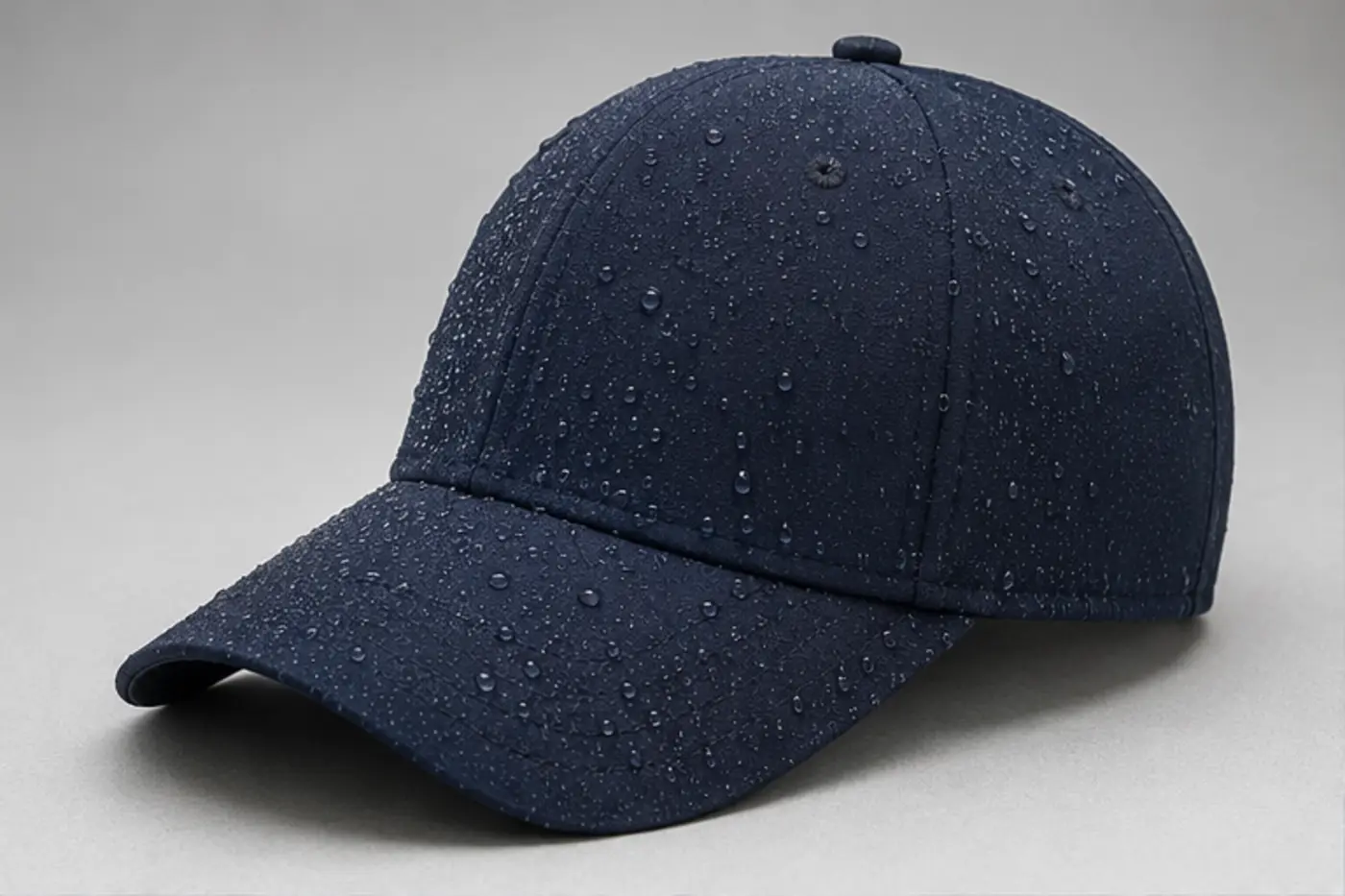
Do not use a dramatic drop demo as the only proof. It may show surface behavior, yet it rarely controls liquid volume, specimen orientation or timing well enough for a repeatable purchase specification.
Frequently asked questions
Is moisture wicking the same as quick drying
No. Wicking describes liquid transport. Drying describes moisture loss over time under stated conditions. A cap program may need both tests.
Should the sweatband be tested as a laminate
Yes when the assembled layers influence performance. A face textile result alone may not represent foam, backing, adhesive and stitching.
Does fabric color affect wicking
Color may arrive with changes in dyeing or finishing. Review representative colorways and retest when the production process changes.
Can a factory drop test replace a laboratory method
It can help screen materials during development. It should not be reported as equivalent to a controlled standard unless the procedure and correlation are established.
When should moisture performance be retested
Review retesting after changes to mill, yarn, fabric construction, finish, lamination, sweatband layers or care instructions.
What should a buyer send for a moisture-wicking cap quote
Send your brand or website, cap style, quantity per style and color, vector logo file, target market, destination, required delivery date and the moisture problem the product needs to solve.
Prepare a moisture-management development brief
Share your brand or website, cap style, quantity per style and color, vector logo file, target market, destination and required delivery date. Add the intended activity, shell and sweatband preferences, care instructions and claim under review. Связаться JoinTop or use the inquiry form at the bottom to align materials, samples and evidence before quotation.


 RU
RU  EN
EN  ES
ES  FR
FR  AR
AR  JA
JA  KO
KO  DE
DE  PT
PT  IT
IT  TR
TR