
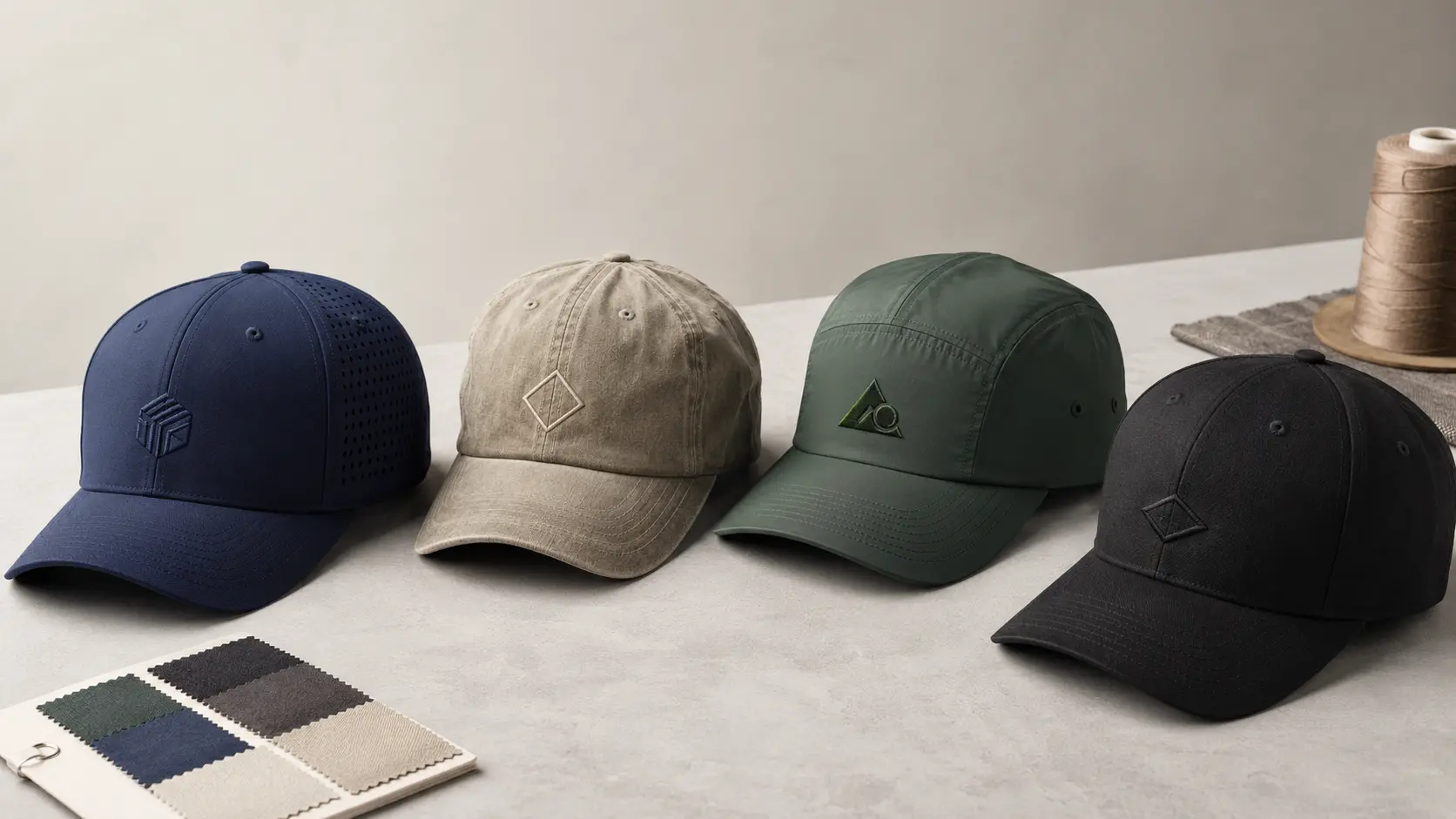
For brands ordering 100 pieces or more, the safest route to successful custom baseball hats is to approve the fit and construction before finalizing decorative details. Start with the wearer, intended use, target price, and delivery market; then choose a proven 5- or 6-panel pattern, suitable fabric, artwork method, and physical sample. A hat can look perfect in a rendering and still feel wrong on the head, which is why fit approval comes before bulk production.
This manufacturing guide is written for lifestyle, golf, outdoor, performance, and corporate buyers sourcing custom baseball hats for brands, private-label collections, or wholesale programs. It covers construction, materials, logo methods, realistic MOQ and cost planning, sampling, lead time, and factory quality control.
Custom Baseball Hat Manufacturing at a Glance
Use this quick summary to decide whether JoinTop fits your program before reading the full guide.
| Planning point | JoinTop reference |
|---|---|
| Typical starting MOQ | 100 pieces per design, subject to fabric, color, and custom-component minimums |
| Development sample | Usually 18–25 days; performance constructions may require additional development or testing |
| Bulk production | Usually 45–50 days after approvals and material readiness; shipping time is separate |
| Product focus | Premium lifestyle, golf, outdoor, and performance headwear |
| Dekoration | Flat and 3D embroidery, woven and printed patches, TPU, silicone, TPR, and heat transfer |
| Production support | Sampling, specification review, material and trim sourcing, bulk production, QC, packing, and EXW or DDP planning |
What Are Fully Custom Baseball Hats?
Fully custom baseball hats are built to a brand’s specifications rather than decorated after a finished blank cap is purchased. A brand can define the crown shape, panel count, brim, fabric, color, closure, sweatband, labels, artwork, and packaging. This gives you more control over fit and brand identity, but it also requires a more complete development process.
If speed and a very small quantity are the priorities, decorating blank hats may be the better route. If the hat is part of a retail collection and the fit, materials, and inside details matter, OEM or private-label manufacturing is usually the stronger choice.
Start With the Customer, Not the Logo
A cap designed for a golf brand should not automatically share the same construction as one for a washed-lifestyle collection. Before requesting a quote, define where the hat will be worn and what the customer should notice first.
- Lifestyle and streetwear: prioritize crown shape, wash effect, color, and distinctive branding.
- Golf and performance: prioritize low weight, moisture management, ventilation, sun protection, and shape recovery.
- Outdoor and fishing: consider water-repellent fabric, quick drying, secure closures, and corrosion-resistant trims.
- Corporate or event use: focus on consistent logo reproduction, budget, delivery date, and broad fit.
This decision prevents an expensive mismatch: a technically impressive cap that does not look like the brand, or a beautiful cap that becomes uncomfortable ten minutes into a warm day.
Quick Recommendation: Which Custom Baseball Hat Should Your Brand Choose?
If you need a practical starting specification, use the combinations below. Final choices should still be verified with your artwork and a physical sample.
| Brand or use | Recommended construction | Recommended fabric | Logo method | Why it works |
|---|---|---|---|---|
| Golf / performance | 5- or 6-panel, lightweight structured | Nylon-spandex or quick-dry polyester | TPU, lightweight transfer, or controlled flat embroidery | Balances ventilation, shape, and low weight |
| Outdoor / fishing | Structured performance cap | DWR nylon or polyester | Silicone or TPR patch | Handles moisture and gives a technical finish |
| Lifestyle | 6-panel unstructured | Washed cotton twill | Flat embroidery or woven patch | Creates a relaxed, retail-friendly look |
| Premium streetwear | Mid- or high-profile structured | Heavy cotton twill or wool blend | 3D puff or high-density flat embroidery | Provides a firm crown and bold logo presentation |
| Corporate / event | Proven mid-profile adjustable cap | Polyester or cotton twill | Flache Stickerei | Controls cost and fits a broad customer group |
Choose the Right Baseball Hat Construction
5-panel or 6-panel?
A 6-panel cap has the familiar athletic silhouette and a center-front seam. It works well for classic baseball hats, structured retail caps, and many performance styles. A 5-panel cap provides an uninterrupted front area, which can make large patches and clean graphic treatments easier. However, “5-panel” describes the panel layout—not one universal fit—so crown height and pattern still need to be specified.
Structured or unstructured?
A structured cap uses supporting material behind the front panels to hold its shape. It offers a crisp presentation and a firm surface for embroidery, including many 3D puff designs. An unstructured cap has a softer front and a relaxed fit. It is a natural match for washed cotton, subtle flat embroidery, and understated lifestyle branding.
Crown profile and brim
Low-, mid-, and high-profile crowns change both appearance and fit. The brim can be flat, slightly curved, or pre-curved, with its length and curve adjusted for the intended market. Do not approve only a front-view rendering. Review the side profile, crown depth, back opening, and brim-to-crown proportion on a physical sample.
Best Fabrics for Custom Baseball Hats
The fabric affects the cap’s silhouette, hand feel, embroidery stability, color, and performance. A useful comparison is:
| Fabric | Best for | Main advantage | Watch for |
|---|---|---|---|
| Baumwolltwill | Classic retail and lifestyle caps | Natural hand feel and reliable decoration | Can absorb moisture and may show wash variation |
| Washed cotton | Dad caps and vintage collections | Soft, broken-in character | Color and measurements need realistic tolerances |
| Polyester | Sport, uniform, and promotional programs | Durable, colorfast, and quick drying | Weight and finish determine whether it feels premium |
| Nylon or nylon-spandex | Outdoor and performance caps | Lightweight with a technical appearance | Heat and needle settings must suit the fabric |
| Wool blend | Heritage and premium structured caps | Rich texture and firm shape | Higher material cost and care requirements |
| Recycled polyester | Sustainability-led programs | Supports recycled-material goals | Verify claims and certification requirements |
Buyers comparing more options can use our baseball cap fabric guide. For environmental programs, review sustainable cap manufacturing materials and sourcing points, then confirm whether a recognized Textile Exchange standard is required for the material claim. Ask for the exact fabric composition and weight; “premium polyester” is a compliment, not a specification.

Select a Logo Method That Fits the Artwork
The best decoration method depends on line thickness, color count, size, fabric, and the desired finish.
- Flachstickerei: versatile and durable for text, icons, and moderate detail.
- 3D-Puffstickerei: creates a bold raised effect, usually best on a stable, structured front panel. Very small text and fine detail can disappear into the foam.
- Woven patch: reproduces smaller details and fine lettering more clearly than many direct embroideries.
- Printed patch or heat transfer: useful for gradients, photographic detail, or lightweight performance designs.
- Rubber, silicone, or TPR patch: gives a modern technical look and strong color definition.
- Leather or faux-leather patch: supports heritage, workwear, and outdoor positioning.
A factory should review the actual vector artwork before confirming the technique. If the logo is complex, request a strike-off or embroidery swatch before the full hat sample. It is a small checkpoint that can prevent a large quantity of fuzzy disappointment.
Private-Label Details That Make the Hat Feel Like Your Brand
Customers may notice the front logo first, but private-label details create a complete retail product. Options include branded seam tape, a woven or printed sweatband label, a custom closure, an under-brim print, interior panel printing, a hangtag, a barcode sticker, and branded packaging.
Use restraint. Every custom detail adds a material, approval, cost, or minimum requirement. Choose the two or three elements that carry the brand most effectively instead of turning the inside of the cap into a tiny trade show.
MOQ, Sampling, Lead Time, and Cost
JoinTop’s typical starting MOQ is 100 pieces per design, subject to the specification. Stock-supported materials and standard trims make smaller launches easier; custom-dyed fabrics, molded closures, branded hardware, and special components may have higher supplier minimums.
Quantity and budget planning
| Quantity | Best suited to | Typical planning range | What changes at this level |
|---|---|---|---|
| 100 pcs / design | First launch or market test | About US$7–9 per cap EXW for many standard constructions | Stock-supported fabric and standard trims usually provide the best flexibility |
| 300 pcs / design | Growing brand or multi-channel launch | Quoted to the final specification | More flexibility in colors and private-label details; component minimums still matter |
| 500+ pcs / design | Established retail or repeat program | About US$5–7 per cap EXW for many standard constructions | Material and setup costs are spread across more units |
Planning ranges updated July 2026. They are not fixed quotations and exclude freight, duties, testing, unusual materials, molds, and premium packaging. Performance constructions and complex decoration can cost more. JoinTop’s standard development sample fee is typically US$60 per style/color, subject to the design.
For scheduling, allow approximately 18–25 days for development samples Und 45–50 days for bulk production after approvals and material readiness. Complex performance styles, testing, custom molds, peak-season capacity, and revisions can extend the schedule. Shipping time is separate.
A useful quotation should clearly state the quantity and color split, fabric, cap structure, artwork size and method, placements, trims, packaging, testing, trade term, and destination. Compare like with like: a cheaper EXW quote is not necessarily a lower landed cost if another quote includes packing, freight, duty, or custom trims. See our detailed custom hat cost guide for the variables behind the unit price.
Support for Pilot Orders and Growing Brand Programs
A 100-piece launch and a repeat retail program should not be managed in exactly the same way. A startup may need stock-supported materials and standard trims to reduce initial risk. A growing brand may need custom colors, branded internal details, repeatable fit, and a production calendar. An established program may also require multi-market packing, testing, third-party inspection, and capacity planning.
JoinTop supports development and production through facilities in China, Vietnam, and Bangladesh. The right production route depends on construction, material availability, order volume, delivery market, compliance requirements, and timing. The practical benefit for a buyer is not simply “more factories”; it is the ability to plan a program around the product and supply-chain requirement instead of forcing every order into one production model.
A Practical Development Process
- Send a clear brief. Include reference photos, target wearer, quantity by color, delivery country, deadline, logo files, and target price.
- Confirm the specification. Lock the panel construction, crown profile, brim, fabric, color standards, closure, sweatband, decoration, labels, and packing.
- Review the mockup and quotation. Make sure the quote matches the latest design rather than an earlier, simpler version.
- Develop a physical sample. Evaluate fit, crown balance, brim curve, color, artwork, comfort, and construction.
- Record every revision. Put approved changes into the tech pack or sample comments instead of relying on scattered messages.
- Approve a final standard. The signed sample and approved specifications should guide bulk production.
- Inspect production. Check materials, work in progress, measurements, workmanship, appearance, labeling, and packing.
Real Development Example: Protecting Crown Shape Before Bulk Production
In one performance-cap development, a brand wanted a bold raised logo on a softer crown. The artwork looked clean on screen, but the first physical trial showed the real risk: the embroidery weight pulled the front panels out of shape. Producing the digital mockup exactly as drawn would have created a good-looking file and an unstable hat.
The development team reviewed the logo size, stitch coverage, embroidery height, front-panel support, and intended fit together. The decoration was adjusted to keep a raised appearance without overpowering the crown, and the revised physical sample became the reference for bulk production.
The buyer lesson: decoration cannot be approved separately from construction. A capable manufacturer should identify that conflict during sampling, explain the tradeoff, and record the approved solution before production—not after cartons are packed.
Quality Checks Brands Should Not Skip
In JoinTop’s production experience, the most common bulk inconsistencies are not dramatic failures. They are small differences that make a retail range look uneven: crown-height variation, an off-center or distorted logo, mismatched brim curves, closure color differences, and incorrect labels or packing.
| Checkpoint | How it should be controlled | Approval reference |
|---|---|---|
| Head opening and fit | Measure on the agreed closure setting and check wearing comfort | Approved specification; a common production tolerance is ±0.5 cm when agreed for the style |
| Crown and panel balance | Check crown height, panel symmetry, back opening, seam alignment, and front profile | Approved sample plus measurement chart |
| Rand | Check length, width, curve, centering, stitching rows, and attachment angle | Approved sample and pattern template |
| Dekoration | Check size, placement, color, registration, puckering, backing, and attachment security | Approved artwork, strike-off, and sealed sample |
| Fabric and trims | Compare fabric lot, shade, sweatband, closure, labels, seam tape, and hardware | Approved swatches, Pantone references where applicable, and trim board |
| Verpackung | Check assortment, quantity, barcode, hangtag, polybag, carton marks, and carton condition | Approved packing instruction and purchase order |
JoinTop checks incoming materials, performs in-line inspection during production, and completes final inspection. A common final-inspection reference is AQL 2.5 for major defects and 4.0 for minor defects, but the sampling plan, measurements, tolerances, and pass criteria should be agreed for each order.
Performance claims require defined test methods rather than marketing adjectives. Depending on the program, buyers may specify colorfastness, shrinkage, dimensional stability, seam strength, water repellency, UV protection, or restricted-substance compliance. AATCC publishes recognized textile test methods, while buyer and supplier must agree on the exact method and pass level before production.
One practical decoration rule from sampling: thick 3D puff embroidery is usually more stable on a structured front panel. For an unstructured or semi-structured cap, flat embroidery or a lightweight patch often preserves the crown shape better. Always approve the actual logo on the intended fabric—not only a digital mockup.
Buyers can review JoinTop’s custom baseball cap manufacturing options Und headwear development and quality capabilities.
What to Send a Manufacturer for an Accurate Quote
Use this checklist to reduce follow-up and receive a more useful quotation:
- cap style or reference sample;
- 5-panel or 6-panel construction;
- structured or unstructured crown and target profile;
- fabric composition, color, and finish;
- logo file, size, technique, colors, and placement;
- closure, sweatband, labels, and packaging;
- quantity per design and per color;
- delivery location, required date, and preferred shipping terms;
- testing or certification requirements;
- target price range, if available.
Frequently Asked Questions
What is the minimum order for custom baseball hats?
JoinTop’s typical MOQ starts at 100 pieces per design, but special fabrics, colors, molded trims, and other custom components can carry separate minimums. Share the full specification for confirmation.
Can I make different colors within one order?
Usually yes, but the minimum per color depends on fabric availability, decoration setup, and component requirements. Confirm the color breakdown before sampling and pricing.
Should I choose embroidery or a patch?
Choose flat embroidery for a classic durable result, 3D puff for bold artwork on a stable crown, and a woven or printed patch for finer detail. Technical rubber patches suit performance and outdoor designs. The artwork and fabric should make the final decision.
Do I need a sample before bulk production?
Yes. A physical sample allows you to verify fit, proportions, fabric, color, decoration, trims, and workmanship. A digital mockup cannot fully show crown shape or comfort.
How long does custom baseball hat production take?
A reasonable planning range is 18–25 days for samples and 45–50 days for bulk production after approvals and material readiness. Add time for revisions, special testing, peak periods, and shipping.
Choose the Next Step That Fits Your Project
Written by Tina at JoinTop and reviewed by the JoinTop headwear development and quality team. This guide reflects practical sampling and bulk-production considerations for brand buyers.
If You Already Have a Tech Pack
Send your tech pack for a manufacturing review. Include the quantity, color breakdown, destination, and target delivery date. JoinTop will review construction feasibility, decoration, material and trim requirements, MOQ factors, sample timing, and the information needed for an accurate quotation.
If Your Design Is Still Being Developed
Send your artwork, reference photos, or product idea. Tell us who will wear the cap, where it will be sold, and your expected quantity. Our team can recommend a suitable hat structure, fabric direction, logo method, private-label details, and sampling plan before you commit to bulk production.
You do not need a perfect specification to start the conversation. A clear design direction and commercial goal are enough for an initial feasibility review.


 DE
DE  EN
EN  ES
ES  FR
FR  AR
AR  JA
JA  KO
KO  RU
RU  PT
PT  IT
IT  TR
TR